

Table of Content
- Introduction: Why the Right Lime Product Matters
- Understanding Calcium Hydroxide Powder
- What is Calcium Oxide Powder Used For?
- Ca(OH)₂ vs CaO: Key Chemical Differences
- Construction Uses: Which Lime Is Better?
- Agricultural Applications: CaO vs Ca(OH)₂
- Safety and Handling Comparison
- Quick Comparison of Properties
- Which One Should You Choose?
- FAQs
- Choosing Quality from Synergy Chemical Industries
Introduction: Why the Right Lime Product Matters
Whether you’re working in construction, agriculture, or manufacturing, understanding the difference between Calcium Hydroxide Powder and Calcium Oxide Powder is essential. Both are lime-based materials, but they behave differently and are suited for different applications.
Choosing the right one can affect performance, safety, and long-term outcomes. At Synergy Chemical Industries, we supply both products, backed by years of experience serving construction professionals, farmers, and industrial clients across India.
Understanding Calcium Hydroxide Powder
Calcium Hydroxide (Ca(OH)₂), commonly known as Hydrated Lime, is a soft white powder formed when Calcium Oxide (CaO) reacts with water. This process is called slaking, and the result is a safer, more stable form of lime.
Typical applications include:
- Whitewashing walls
- Plaster and mortar preparation
- Water treatment and pH balancing
- Agricultural soil amendment
It is easier and safer to use than quicklime, making it ideal for construction crews and on-site applications.
What is Calcium Oxide Powder Used For?
Calcium Oxide (CaO), also known as quicklime, is produced by heating limestone in a kiln to remove carbon dioxide. This leaves behind a highly reactive, dry compound.
It is widely used in:
- Cement and concrete production
- Soil stabilisation in road construction
- Steel and metallurgy industries
- Sugar refining and waste treatment
Quicklime must be handled carefully as it reacts violently with water, releasing heat in an exothermic reaction.
Ca(OH)₂ vs CaO: Key Chemical Differences
Understanding the chemical distinction is important for selecting the right material. Here’s a quick comparison:
| Property | Calcium Hydroxide (Ca(OH)₂) | Calcium Oxide (CaO) |
| Common Name | Hydrated Lime | Quicklime |
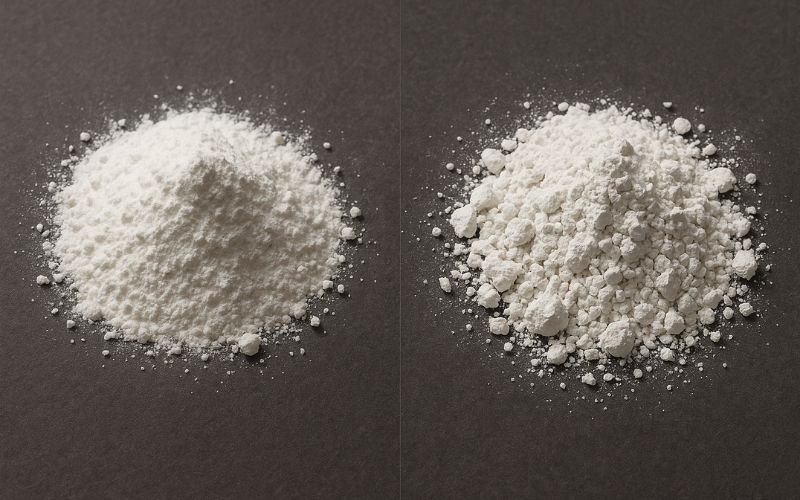
| Physical Form | Fine white powder | Greyish-white lumps or powder |
| Reactivity | Moderate | Highly reactive |
| Reaction with Water | Already hydrated | Exothermic (releases heat) |
| Safety | Safer to handle | Corrosive and hazardous |
| Chemical Reaction | Stable | Converts to Ca(OH)₂ upon hydration |
Hydration Reaction:
CaO + H₂O → Ca(OH)₂ + Heat
This reaction highlights why CaO should never be added directly to wet applications without proper care.
Construction Uses: Which Lime Is Better?
Lime-based materials have been used in construction for centuries. But not all lime is created equal. Here’s how the two types compare for building purposes:
Calcium Hydroxide (Ca(OH)₂):
- Used for plaster, mortar, and lime wash
- Easy to mix and apply
- Suitable for restoration of heritage buildings
- Provides a smooth, aesthetic finish
Calcium Oxide (CaO):
- Used in dry soil stabilisation
- Common in cement blending and base layers
- Must be slaked before use in finishes
- Offers strong binding properties in industrial applications
| Construction Use | Recommended Lime Type |
| Whitewashing | Calcium Hydroxide |
| Mortar for brickwork | Calcium Hydroxide |
| Soil stabilisation | Calcium Oxide |
| Cement manufacturing | Calcium Oxide |
| Heritage restoration | Calcium Hydroxide |
Agricultural Applications: CaO vs Ca(OH)₂
Lime is a key ingredient in soil conditioning, especially in acidic regions. But which one is better for agriculture?
Calcium Hydroxide (Ca(OH)₂):
- Safe and effective for neutralising soil pH
- Improves long-term soil structure
- Suitable for crops and microbial life
Calcium Oxide (CaO):
- Fast-acting pH correction
- Better for large-scale or commercial applications
- Must be applied with care due to heat generation
For most farming operations, Calcium Hydroxide is the better choice due to its ease of use and minimal risk.
Safety and Handling Comparison
Which is stronger: Calcium Hydroxide or Calcium Oxide?
Calcium Oxide is more chemically aggressive. It generates heat upon contact with moisture and can cause serious burns.
| Safety Aspect | Calcium Hydroxide (Ca(OH)₂) | Calcium Oxide (CaO) |
| Reactivity | Moderate | High |
| Heat Generation | None | Yes (exothermic reaction) |
| Skin Contact | Mild irritation | Severe burns possible |
| Handling Requirements | Basic PPE (gloves, mask) | Full PPE (face shield, gloves) |
Both should be stored in a dry place and handled with appropriate protective gear. Synergy Chemical Industries provides safety guidelines with every product shipment.
Quick Comparison of Properties
| Feature | Calcium Hydroxide (Ca(OH)₂) | Calcium Oxide (CaO) |
| Common Name | Hydrated Lime | Quicklime |
| State | White powder | Grey/white lumps |
| Reactivity | Low to moderate | High |
| Safety | Relatively safe | Requires caution |
| Construction Use | Whitewash, mortar | Cement, soil stabilisation |
| Agriculture Use | Soil pH correction | Industrial pH control |
Which One Should You Choose?
The right product depends on your needs:
- For safe, ready-to-use applications, go with Calcium Hydroxide
- For high-temperature or industrial processes, Calcium Oxide is ideal
- For agriculture, use Ca(OH)₂ unless rapid correction is required
- For construction finishes, Ca(OH)₂ is more user-friendly and aesthetically compatible
Synergy Chemical Industries supplies both forms with guaranteed purity and consistent quality, helping customers make the best choice for their specific industry.
FAQs: Calcium Hydroxide vs Calcium Oxide
Q1. What is the difference between Ca(OH)₂ and CaO?
Answer: Ca(OH)₂ is Hydrated Lime, already reacted with water. CaO is Quicklime, a dry and reactive form that must be slaked.
Q2. Is calcium hydroxide safer than calcium oxide?
Answer: Yes, it is more stable and doesn’t produce heat on contact with water.
Q3. Which lime is better for agriculture?
Answer: Calcium Hydroxide is safer and easier to apply in most farming scenarios.
Q4. Can calcium oxide be used for whitewashing?
Answer: No, it must first be converted into hydrated lime before application.
Q5. What happens when calcium oxide reacts with water?
Answer: It reacts exothermically, producing heat and forming calcium hydroxide.
Q6. Why is hydrated lime used in construction?
Answer: Because it’s safer to handle and mixes well into mortars and plasters.
Q7. Are both forms of lime environmentally safe?
Answer: Yes, both are naturally occurring, non-toxic, and biodegradable when used correctly.
Choosing Quality from Synergy Chemical Industries
Understanding the chemical difference between calcium hydroxide and calcium oxide is essential for getting the results you want safely, efficiently, and cost-effectively.
Whether you’re stabilising soil, preparing lime plaster, or correcting soil pH, Synergy Chemical Industries provides top-grade lime products manufactured with precision. Our products are tested for purity and performance and are ready for delivery across India.
Explore our product range today to find the right lime for your project.