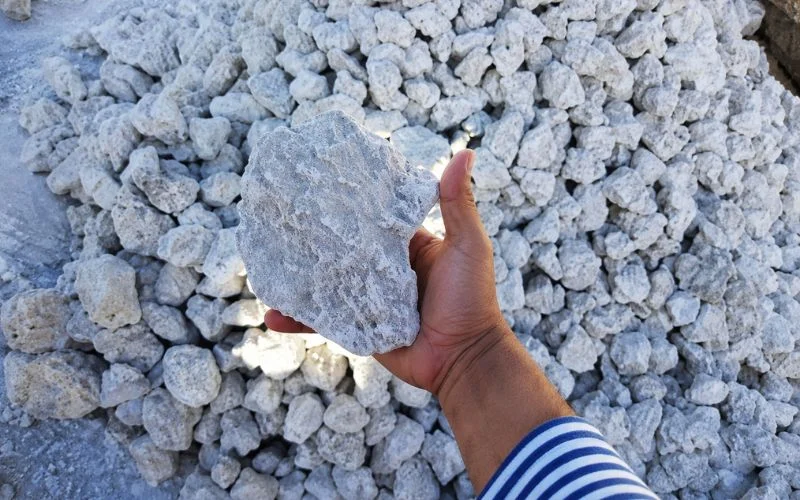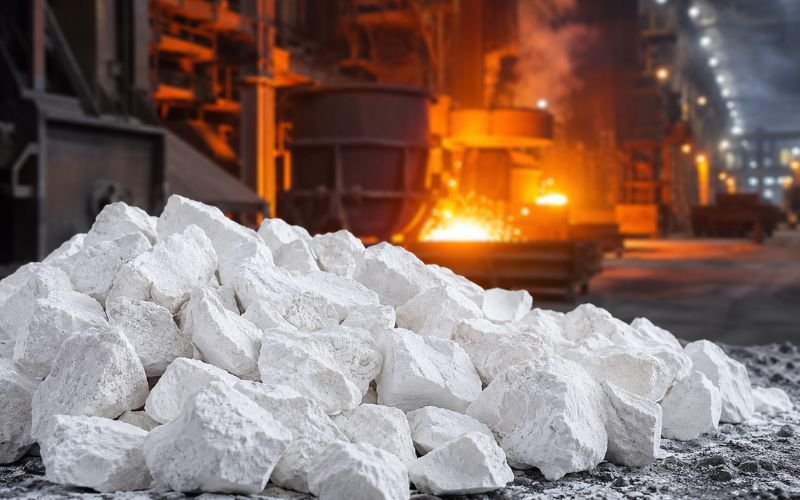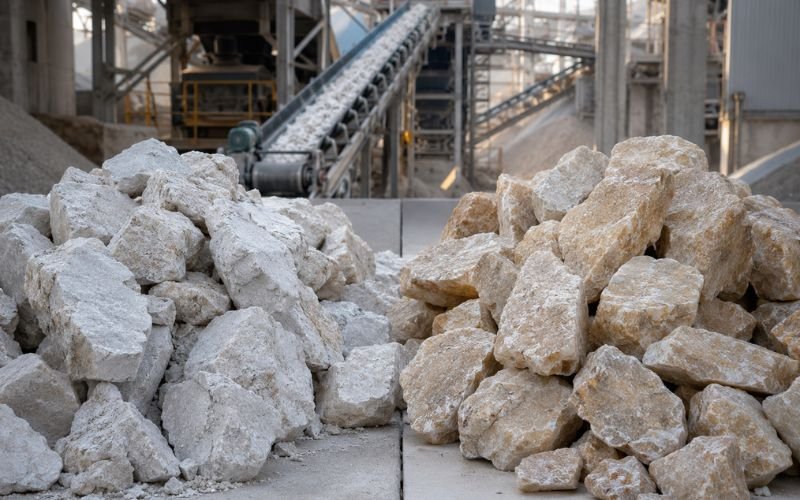
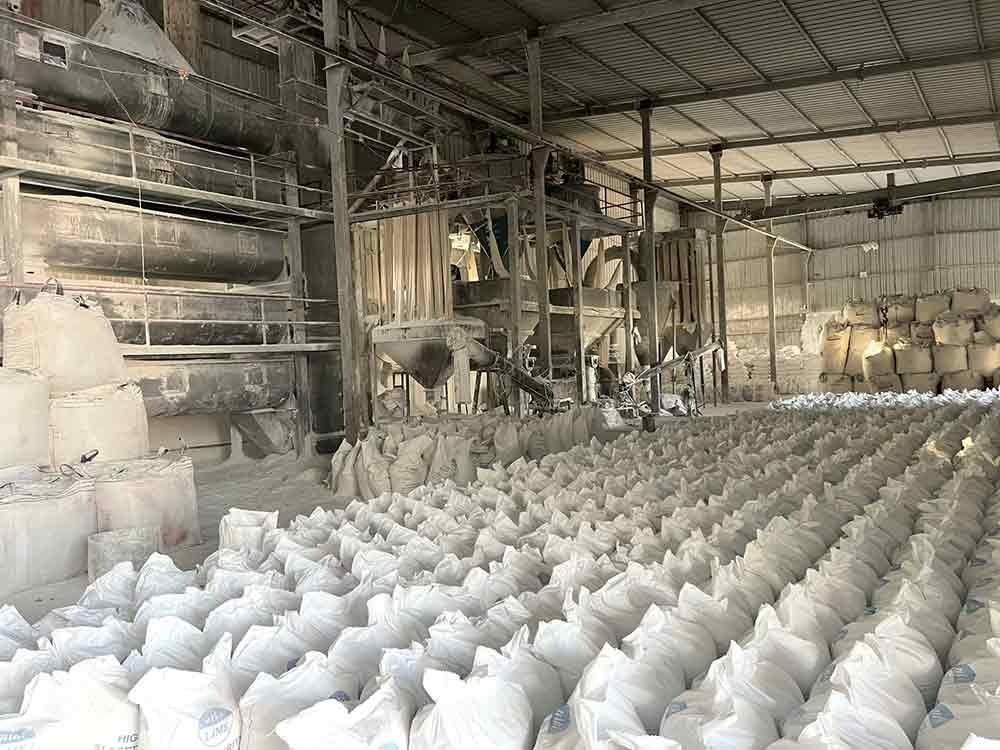

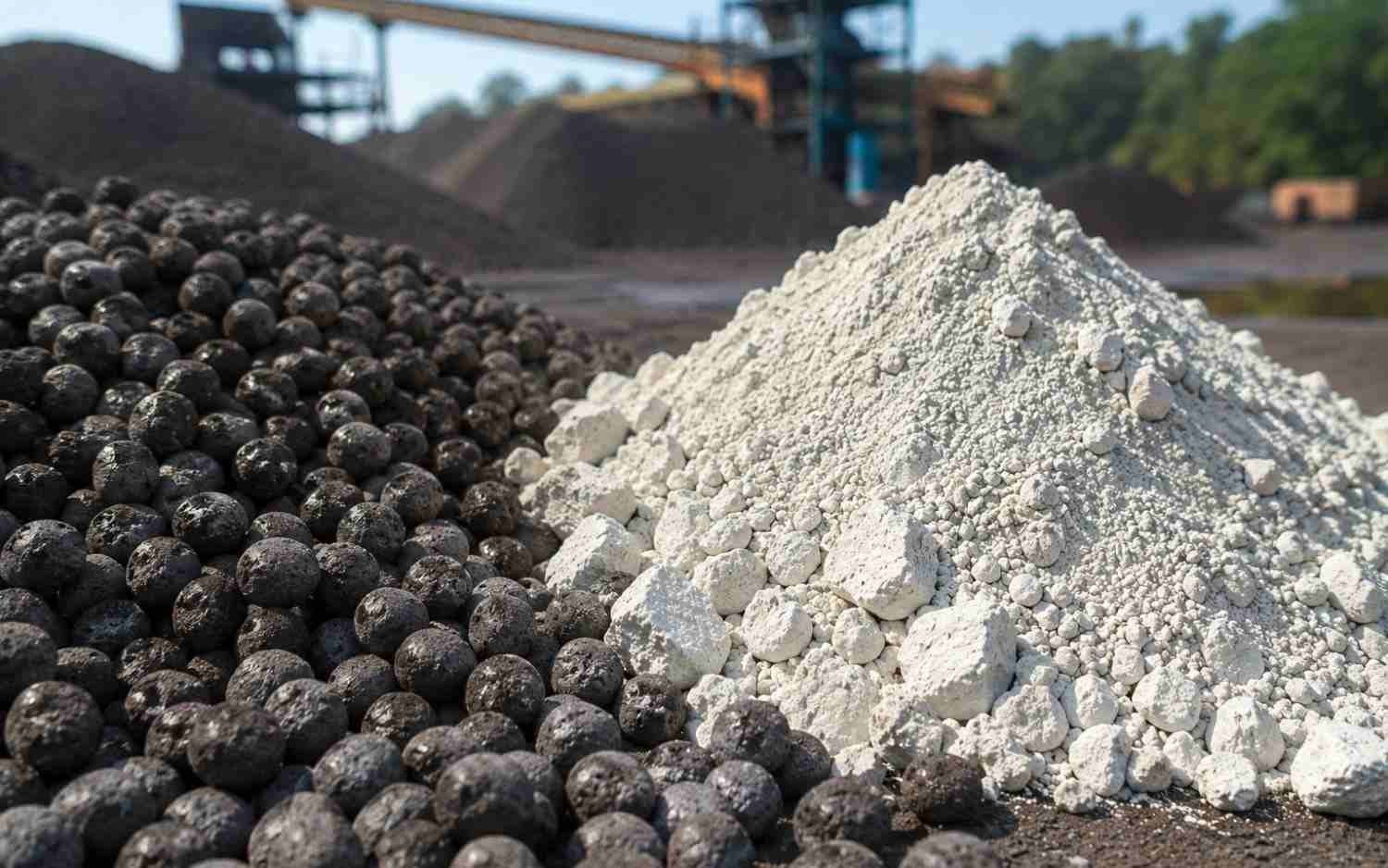
Iron ore pelletization uses limestone as an important flux because it supplies calcium during pellet production. In the pelletization process, the main component of limestone, calcium carbonate (CaCO₃), decomposes during heating to form calcium oxide (CaO) and carbon dioxide (CO₂). The resulting CaO contributes to pellet chemistry and helps control basicity.
The required limestone dosage in pelletization varies between pellet plants. It depends on iron ore chemistry, target basicity, existing CaO and MgO, limestone quality, other fluxes, and downstream ironmaking requirements. Pellet producers should therefore evaluate both the chemical and physical quality of limestone before selecting a suitable supplier.
What Is the Role of Limestone in Iron Ore Pelletization?
Limestone is primarily used as a fluxing material in iron ore pellets. When the pellet mix enters the induration process, heat decomposes calcium carbonate according to the reaction:
CaCO₃ → CaO + CO₂
The calcium oxide produced during this reaction contributes to the chemical balance of the pellet. It can react with silica and other oxides and influence the mineral phases and slag chemistry formed during high-temperature processing.
One of the main reasons pellet plants use limestone is to adjust basicity. A commonly used basicity expression is:
Basicity = CaO / SiO₂
A plant may use another basicity index depending on its process and product specification, so engineers should always use the definition applicable to their own operation.
Limestone therefore should not be considered simply as an additive that improves pellets. Its purpose is to help the plant achieve the required chemical composition and high-temperature behaviour.
Why Is Limestone Added to Iron Ore Pellets?
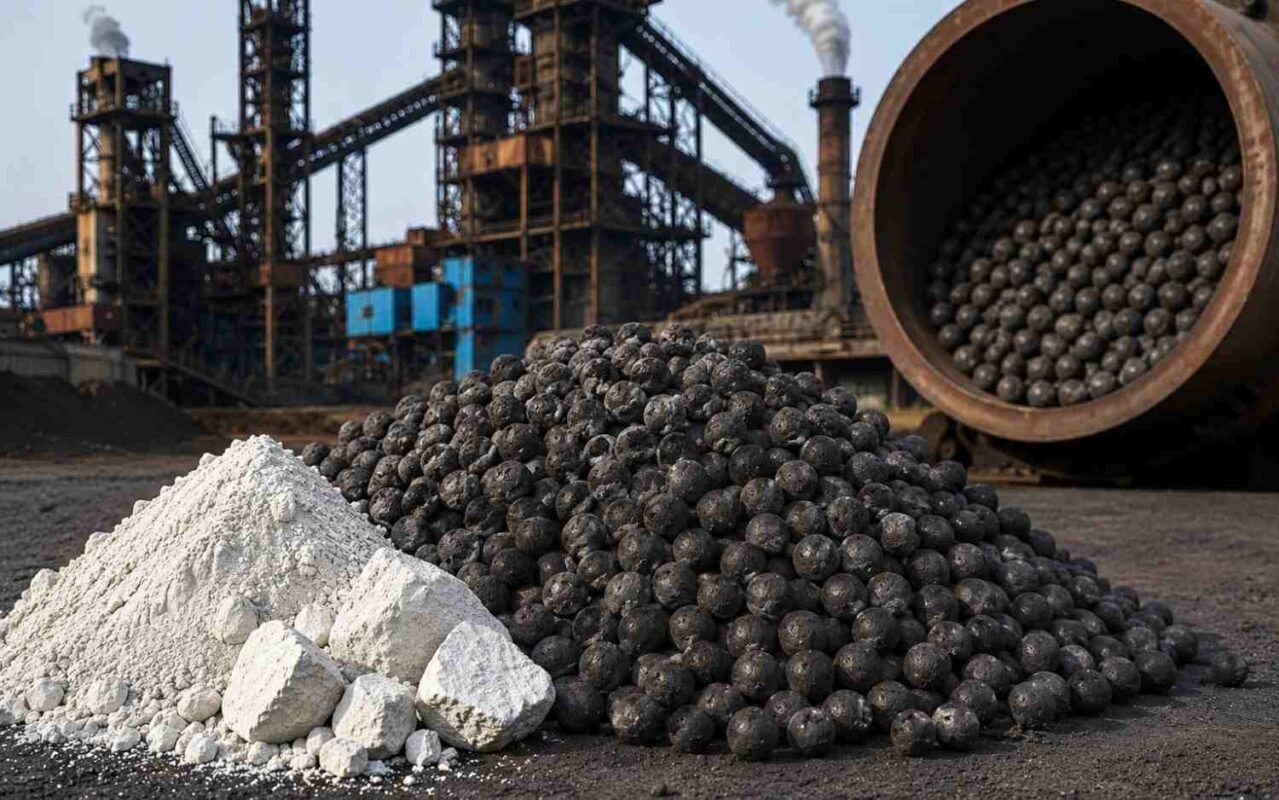
Limestone provides a calcium source that becomes CaO during induration. The CaO contributes to the pellet’s basicity and influences reactions involving silica and other gangue components.
The effect of limestone extends beyond pellet chemistry. Changes in flux addition can influence the mineral phases formed during induration, which can affect properties such as pellet strength and reducibility. However, these effects depend on the complete pellet formulation and firing conditions.
For example, it would be inaccurate to say that adding more limestone always increases pellet strength. Pellet strength depends on ore mineralogy, binder, porosity, induration temperature, residence time, flux chemistry and other variables.
The same principle applies to reducibility. Limestone can influence pellet structure and mineral phases, but the final reduction behaviour depends on the complete pellet system.
How Much Limestone Is Used in Iron Ore Pelletization?
There is no universal limestone dosage for iron ore pelletization. The required amount depends on the chemistry of the iron ore concentrate and the target chemistry of the finished pellets.
Important factors include:
- Iron ore Fe and SiO₂ content.
- Existing CaO and MgO.
- Target basicity.
- Limestone CaCO₃ and CaO contribution.
- Other fluxes such as dolomite or quicklime.
- Blast furnace or DRI requirements.
For a simple CaO/SiO₂ basicity calculation, the required CaO can be estimated from the target basicity and silica content. The plant then considers the CaO already present in the ore and the contribution from other fluxes before calculating the limestone requirement.
For example, if a simplified pellet mix contains 4 kg of SiO₂ and the target basicity is 1.0, the target CaO would be 4 kg under the simple CaO/SiO₂ definition. If the feed already provides 0.8 kg CaO, the additional requirement would be 3.2 kg. The actual limestone addition would then depend on the limestone’s effective CaO contribution.
This is an illustrative calculation, not a universal industrial recipe. Real pellet plants require complete feed, flux and product chemistry before setting dosage.
Limestone Quality Requirements for Pelletization

Limestone quality affects the accuracy of the pellet chemistry and the stability of the production process. A pellet plant should therefore evaluate several parameters instead of selecting material based only on CaCO₃ content.
| Parameter | Why it matters |
| CaCO₃ | Indicates carbonate content and potential calcium contribution |
| CaO | Relevant to pellet chemistry and basicity |
| MgO | Influences pellet and slag chemistry |
| SiO₂ | Affects basicity and gangue balance |
| Al₂O₃ | Can influence slag behaviour |
| LOI | Indicates mass loss during heating |
| Moisture | Affects dry-material dosing and handling |
| Particle size / fineness | Influences mixing, distribution, reactivity and process behaviour |
| Fineness | Affects distribution and process behaviour |
CaCO₃ is an important indicator because it represents the carbonate component of limestone. Pure CaCO₃ has a theoretical CaO equivalent of about 56% after complete decomposition. Commercial limestone can provide a different effective contribution because of impurities, moisture, and other minerals.
SiO₂ and Al₂O₃ also deserve attention because they become part of the overall pellet chemistry. Additional unwanted gangue can affect the balance that the pellet plant is trying to achieve.
MgO can influence pellet and downstream slag chemistry. Its preferred level depends on the pellet specification and ironmaking process.
Why Does Limestone Particle Size Matter?
Chemical composition alone does not completely describe limestone performance. Particle size and fineness can influence mixing, distribution within green pellets and reaction during induration.
A finer material can distribute differently from a coarse material and may provide greater contact with other pellet components. However, the optimum particle size depends on the plant’s grinding equipment, mixing system and induration conditions.
This means two limestone sources with similar chemical analyses can still behave differently in a pellet plant. Buyers should therefore include physical characteristics in the supplier specification and evaluate them during trials.
Limestone vs Quicklime vs Hydrated Lime

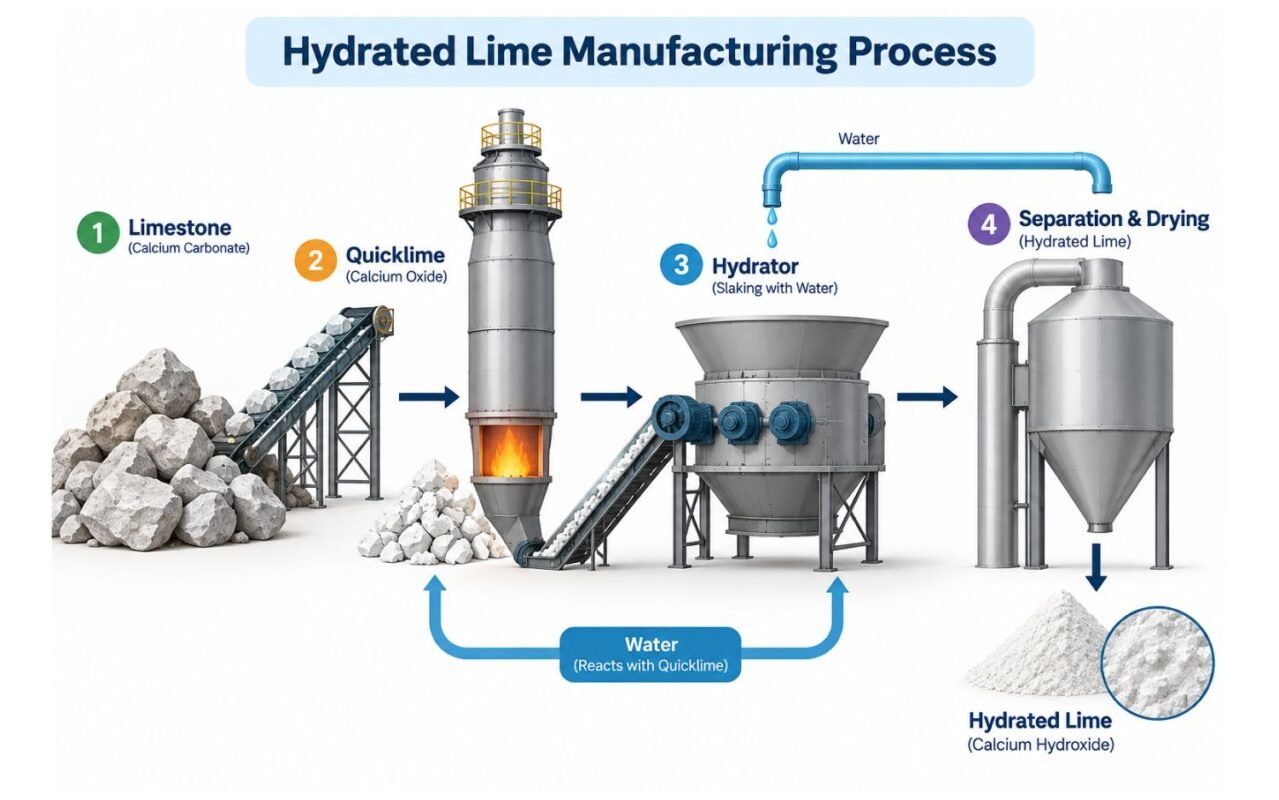
Limestone, quicklime and hydrated lime are chemically different materials. Limestone is primarily composed of calcium carbonate (CaCO₃), while quicklime is mainly calcium oxide (CaO) and hydrated lime is calcium hydroxide [Ca(OH)₂]. Dolomite or dolostone contains both calcium and magnesium carbonates.
Limestone must undergo calcination to form CaO:
CaCO₃ → CaO + CO₂
Quicklime already contains CaO, while hydrated lime results when quicklime reacts with water:
CaO + H₂O → Ca(OH)₂
These materials should not be treated as interchangeable. A pellet plant considering an alternative flux must evaluate its chemical contribution, handling characteristics and process performance through appropriate testing.
Synergy Chemical Industries is a hydrated lime manufacturer in Rajasthan, India. Organisations evaluating hydrated lime for suitable industrial applications can discuss their requirements with Synergy Chemical Industries. However, hydrated lime should not be assumed to be a direct replacement for limestone in iron ore pelletization without technical evaluation.
How Should Pellet Plants Select Limestone?
A good limestone-selection process starts with the required pellet chemistry, not simply the supplier’s advertised dosage. Engineers should evaluate Fe, SiO₂, CaO, MgO, basicity, particle size, moisture, and batch consistency before approving a material. Laboratory or plant trials can then help confirm its suitability for the specific process.
For industries looking for quality lime solutions, Synergy Chemical Industries offers hydrated lime for suitable industrial applications. The right product can be evaluated according to your process requirements, chemistry, and intended application.
Limestone Selection for Better Pellet Chemistry
Limestone plays an important role in iron ore pelletization by supplying calcium and helping control pellet basicity and chemistry. The right dosage depends on the ore chemistry, target basicity and overall process requirements, so plants should evaluate both chemical and physical limestone quality.
For industries exploring hydrated lime for specific applications, Synergy Chemical Industries can be considered as a potential partner for understanding suitable product options based on individual process requirements.
FAQs
Q1. What is the role of limestone in iron ore pelletization?
Answer: Limestone primarily acts as a flux and calcium source in iron ore pelletization. Its calcium carbonate (CaCO₃) decomposes during induration to form calcium oxide (CaO), which contributes to pellet chemistry and helps control basicity.
Q2. How much limestone is used in iron ore pelletization?
Answer: There is no fixed limestone dosage for every pellet plant. The required amount depends on iron ore chemistry, target basicity, existing CaO and MgO, limestone composition, other fluxes and downstream ironmaking requirements.
Q3. What quality of limestone is required for pelletization?
Answer: Important quality parameters include CaCO₃, CaO, MgO, SiO₂, Al₂O₃, LOI, moisture, particle size and fineness. Pellet plants should establish their own acceptance limits according to their feed chemistry and process requirements.
Q4. How does limestone affect pellet basicity?
Answer: During induration, limestone decomposes and produces CaO. Under the commonly used simple formula Basicity = CaO / SiO₂, the additional CaO can increase the pellet’s basicity. The target depends on the specific pellet and downstream process.
Q5. Can hydrated lime replace limestone in iron ore pelletization?
Answer: Hydrated lime cannot automatically be treated as a direct replacement for limestone because hydrated lime is Ca(OH)₂ while limestone is CaCO₃. Any substitution should be assessed through chemical calculations and appropriate laboratory or plant trials.